MinimizingFlaringandEmissions
Climatechangeposesasignificant risk for
our business, both inmeetinganticipated
legislativeandpolicy requirementsand in
adapting to itspotential physical impacts.
Identifying appropriate responses that
seek tobalance the needs for economic
development, jobcreation, energysecurity
and emissions reductions represents
one of the greatest challenges of our
generation.We seek to activelymanage
andminimize theemissionof greenhouse
gasesper unit of natural gasweproduce,
particularly through flare reduction.
Flaring is required as an essential safety
feature of gas refinery operations,
despite contributing heavily to the
carbon footprint of gas companies.
The controlled combustionof excess
gas is necessary toprotect equipment
fromdamagedue tooverpressure,
reducing the risk of a fire or explosion
inside theplant. Pilot flames,
continuously lit by a steady supply of
natural gas, calledpurge gas, ensure
that any gas released to the flareswill
be ignited safely.
We aim to reduce our flaringwhile
maintainingoptimal safety and
productivity. At the endof 2012,
wewere able to lower our volumes of
purge gas by installing infrared cameras
that allowus todetect andmonitor
smaller pilot flames that are invisible
to the naked eye. As a result, Dolphin
Energywas able to reduce its flaring
by 20% from 2012 to2013.
More importantlyDolphinEnergy
achieved, for the first time, an annual
flaring ratebelow 0.3%of our natural
gas export, which is theConsent to
Operate target. This is a considerable
achievement since this performance
includes all emergency flaring and
all routine flaring, including flaring
associatedwith the annual maintenance
shutdown and start-upof half of the
operating facility. DolphinEnergy’s 2013
flaringperformancewas 0.28%of
natural gas production and export.
DolphinEnergy is an activemember of
theQatar PetroleumGlobal Gas Flaring
Reduction Initiative, formed todevelop
and implementmethods to reduce
flaring and venting volumes. In 2014,
DolphinEnergy plans to complete a flare
reduction feasibility study, investigating
solutions to achieve zero flaring.
Protect theEnvironment
continued
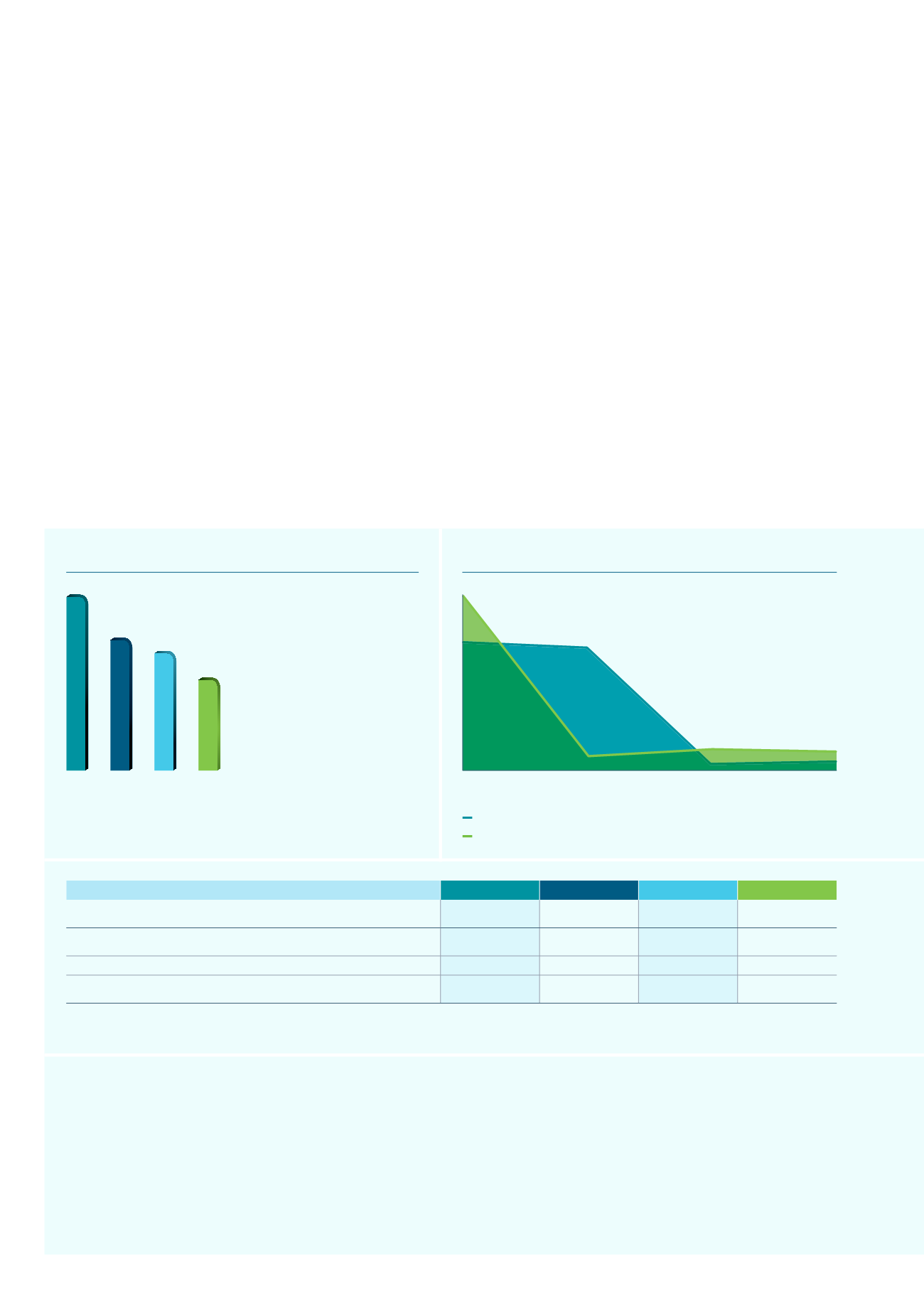
Flaring (Qatar)*
2010
2011
2012
2013
Flaring (MMscf)
4,554
3,686
3,370
2,713
Volume of Onshore Flaring
4,173
3,344
2,992
2,357
Volume of Offshore Flaring
381
342
378
356
Flaring Intensity (MMscf/mmBOE)
23.9
17.6
16.1
13.0
*Our reportingmethodology has been improved; previous years’ data has been revised accordingly.
2010 2011 2012 2013
0.28
0.36
0.40
FlaringasaPercentageofGasAvailable forSale (Qatar)
0.53
Venting (Kuwait)
2010
2011
2012
2013
Venting alongKuwaitGasNetwork (MMscf)
Venting at TaweelahReceivingFacility (MMscf)
21.07
2.41
1.05
3.60
3.19
1.47
30
22
20
%
DolphinEnergywas able
to reduce its flaringby 20%
from 2012 to 2013
0.28
%
DolphinEnergy’s2013flaring
performancewas0.28%of natural
gasproductionandexport
40


