Personal Safety
DolphinEnergy ranksworkplace safety
as one of its toppriorities.We strive to
makepersonal andprocess safety an
integral part of our workplace culture –
a sharedmindset thatmust be supported
andpracticed. Given that Dolphin
Energy’s 2012 incident trend analysis
identified a failure to follow rules and
a lack of attention as the two leading
causes of incidents, DolphinEnergy
implemented a campaign in 2013 to
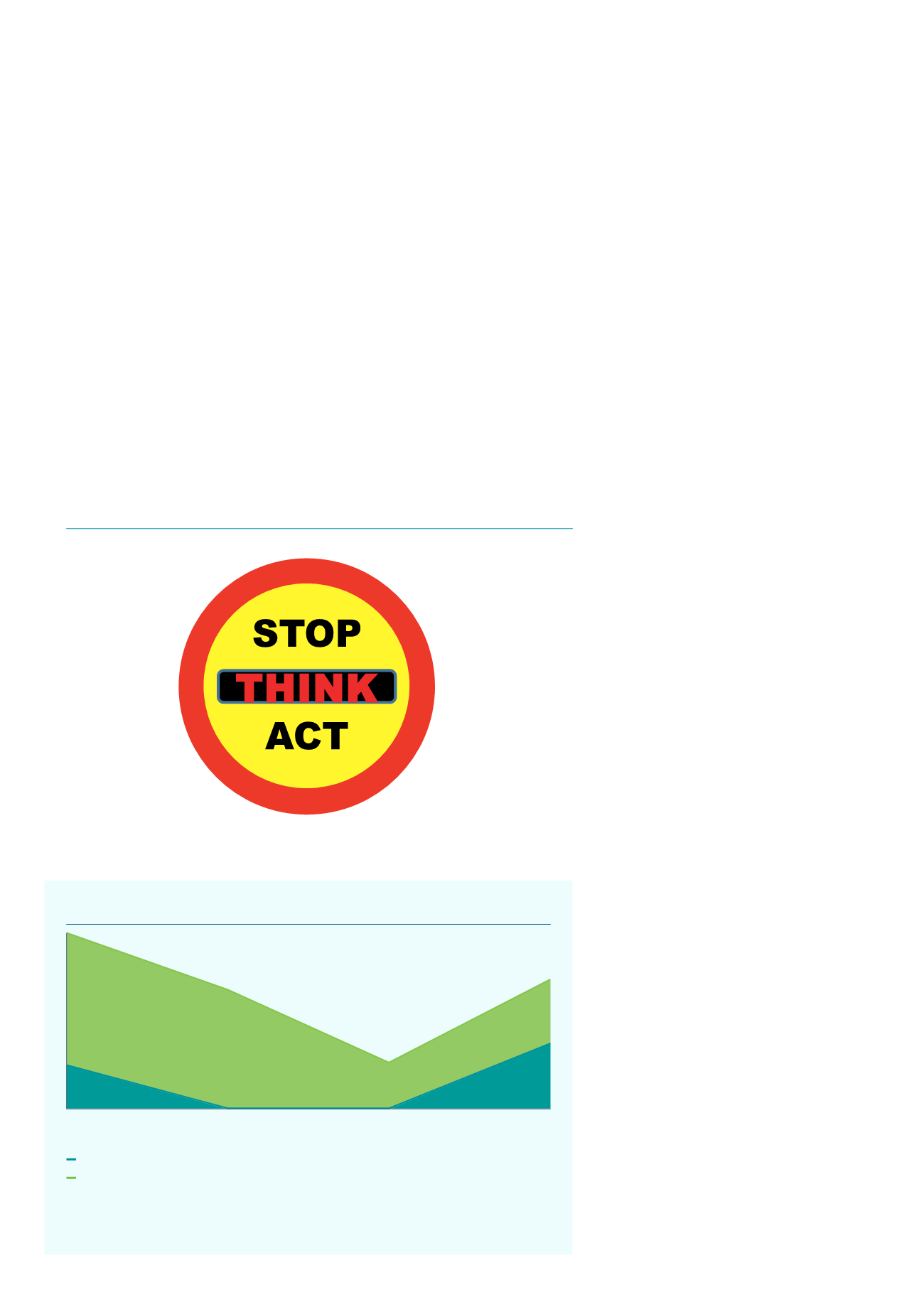
encourage all employees to 'stop and
think' beforebeginning every job inorder
to act to control any hazards. This
campaignwill be implemented in 2014
on amuchwider scale to cover all
Dolphin facilities andoffices to ensure
proper awareness.
A lack of trainingwas also identified
as a leading cause of incidents in 2012;
DolphinEnergy therefore created
SAFETYpassports for its upstream
employees. These ID cards contain a
recordof theHSE training an employee
has completed; supervisorswill
use them to ensure that no task is
undertakenwithout theproper training.
In the coming year, weplan to enhance
our HSE trainingprocedures to ensure
they remain in linewith industry best
practice.Wewill also conduct a
company-wide safety culture survey to
understandbetter howwe candevelop
an even stronger safety-firstmindset.
Our employee lost-time incident rate
increased to 0.45 this year withone
unfortunate incident when a Taweelah
operator took amisstepoff a low
platform and fractured his ankle. The
Upstream sector average for lost-time
incident rateswas 0.16 in 2012.
1
The
recordable injury frequency among
DolphinEnergy employees increased
from a rate of 0.32 in 2012 to a rate
of 0.89 in 2013. TheUpstream sector
average for total recordable injury rates
was 0.43 in 2012.
2
We continue to seek
to eliminate all workplace incidents.
ProcessSafety and
EmergencyPreparedness
DolphinEnergy seeks to avoidprocess
accidents and incidents fromoccurring
by focusingonprevention throughwell-
trained employees, rigorously controlled
workingprocedures, vigilance, and
ongoingmaintenance of equipment.
This is coordinated through careful
planning and regular risk assessments.
In 2013, DolphinEnergy established
ProcessSafety performance reporting
using nine lagging and leading indicators
reportedon amonthly basis.
You can readmore about our approach
toprocess safety and riskmanagement
onour website:
and-s/process-safety-and-risk-management
We had two reportable loss-of-
containment incidents in 2013; neither
resulted in a release to the environment.
Wedefine a loss-of-containment
according toAmericanNational
Standards Institute/AmericanPetroleum
Institute (ANSI/API) RPRecommended
Practice (RP) 754.
In the event that a loss-of-containment
incident or other emergency should
occur, we are committed to addressing
it as quickly and as safely as possible.
DolphinEnergy continually strives
to ensure a state of preparedness
in the event of any emergency or crisis.
To that end, we have communicated
crisis and emergencymanagement and
responseplans andprocedures across
all divisions anddepartments through
training sessions and specialized
workshops. TheHSE&Sdivision has
conducted a series of 'lessons learned'
workshops for our HumanResources,
PublicRelations andCorporate
Communicationsdivisions, basedon
previous exercises and current best
industry practice.
Put Our PeopleFirst
continued
1
| Qatar Energy and Industry Sector SustainabilityReport 2012
)
2
| Ibid.
Lost-Time Incident Rate for Employees
Total Recordable InjuryRate for Employees
0.82
0
0.32
0
0.89
0.45
1.21
0.3
2010
2011
2012
2013
Personal Safety
22


