53
In 2010DolphinEnergy intends to further
reduce gas flaringand venting through:
•
Maintainingongoing surveillance by
the task forceof the performanceof the
repaired export compression facilities
•
Initiating aLeakDetection andRepair
(LDAR) system at RLC to reduce
fugitiveemissions
14
12
10
8
6
4
2
0
2007
2008
2009
MMscf
Venting
2.37
2.86
12.67
Venting at Taweelah
VentingKuwait gas network
Plant upsets
Valves passing
16,000
14,000
12,000
10,000
8,000
6,000
4,000
2,000
0
2008
2009
Gas sent to flare (tons)
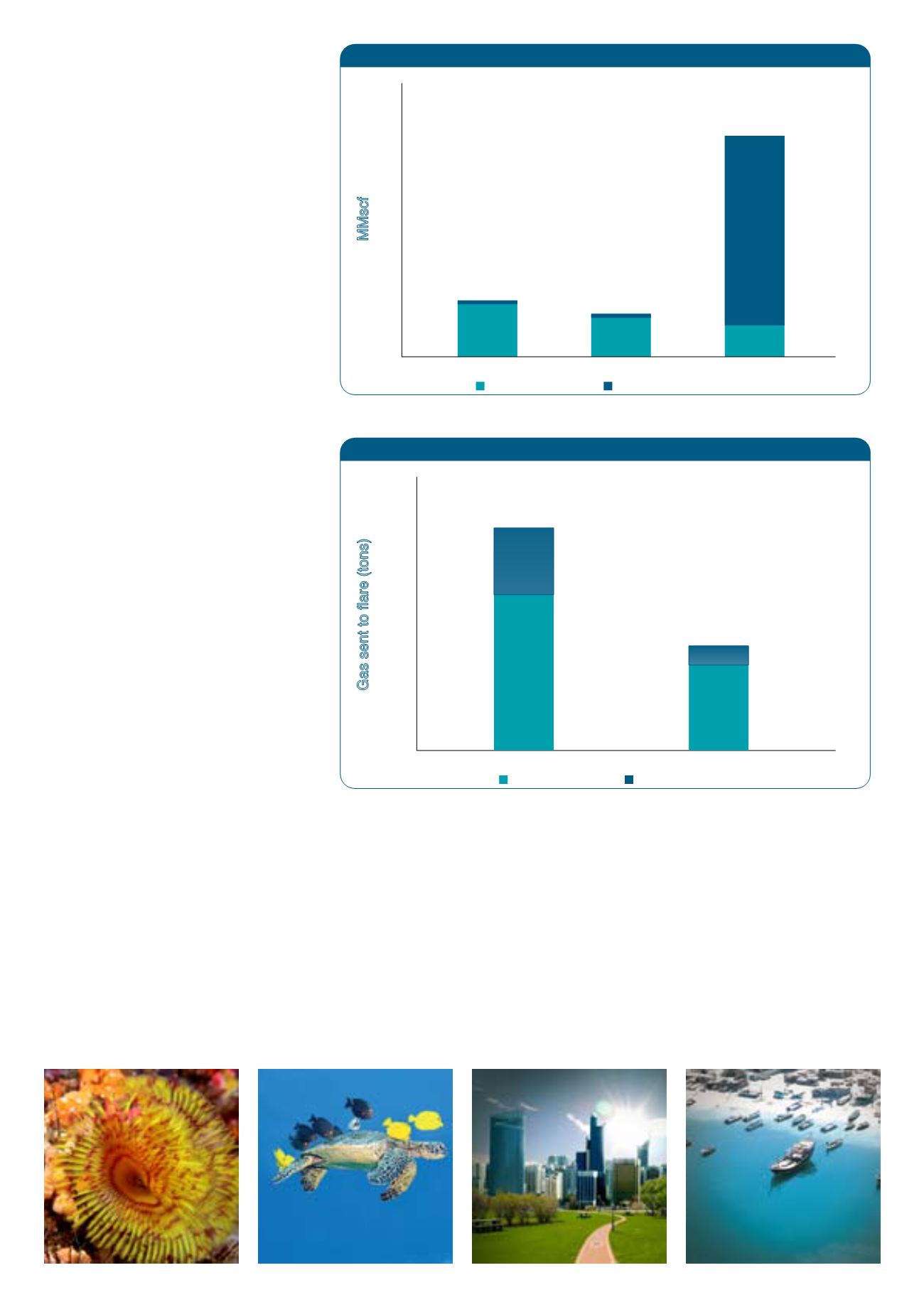
Key 2009Flaring Improvements
13,941.15
6,277.58
•
Undertakinga full analysis to determine
the technologies and costs required to
achieve zero flaring
•
Undertakinga planned shut down
that will allow for fine-tuning and
commissioning of work on any
equipment to ensure that it performs
within designed specifications.
•
As a result of theabove, target 0.3%
flaring of sweet gas production in 2010.
Globally, flaring and venting of natural
gas from oil and gaswells is a significant
source of greenhousegas emissions.
As a result of industry efforts, its global
contribution to greenhouse gases has
declined by three-quarters in absolute
terms since the 1970s, but still accounts
for 0.5% of all man-made carbon dioxide
emissions. At DolphinEnergy, significant
progress has beenmade in reducing
flaring andoperational venting since the
beginning of operations.
In 2009, DolphinEnergy spearheaded
an integrated taskforce comprising
suppliers, operationpersonnel, technical
services andQHSE&Sdivision to
identify opportunities tominimize gas
flaring andGHG emissions caused by
unplannedprocess upsets and export
gas compressor (EGC) availability. which
hadbeen identifiedas amajor source of
flaring.Acomprehensivework program
was subsequently initiated calling for the
following action items:
•
Repairing of passing valves
•
Optimization of purgegas rate to flare
•
Improvement of reliability of Export Gas
Compressor (operations and avoiding
trips to flare)
•
Calibration of flaremeters
As a result of actions taken, themonthly
percentage of processed gas sent to the
flarewas significantly reduced from 4% in
February 2009 to less than0.5% inAugust
2009.
Unfortunately, in 2009 an emergency
occurred during hot tapping activities
on theAFPpipeline in theKuwait that
required ventingof 30km of pipeline. This
accounted for 11.26MMscf of the total
11.44MMscf of Kuwaitnetwork venting in
2009.
FlaringandVenting of
GHGEmissions


