16
17
Kames Petroleum Services
SUSTAINABILITY REPORT 2014
Level of
Materiality
Rank Kames Petroleum Services Material Issues
GRI Material Issues
Chapter Most Concerned
Stakeholders
Highly
Material
1
Safety and Security
Occupational Health and Safety, Asset
Integrity and Process Safety
3
2
Compliance with Regulations
Compliance
6
3
Transparency, Accountability
and Integrity
Ethics and Integrity, Anti-corruption
6
4
Reliable and Efficient Operations
N/A
2
5
Emergency Preparedness
Emergency Preparedness
2
6
Protection of the Environment
Water, Effluents and Waste, Compliance,
Overall
5
7
Achieving Operational and Financial
Targets
Economic Performance
2
Somewhat
Material
8
Employee Health and Wellbeing
Occupational Health and Safety
3
9
Risk Management and Business
Continuity
N/A
2
10 Customer Satisfaction
Product and Service Labelling
2
11
Stakeholder Engagement and
Communication
N/A
1
12
Research, Development and Innovation N/A
5
13
Employee Engagement and
Satisfaction
Employment
3
14 Sustainable Supply Chain
Procurement Practices
6
Least
Material
15
Adopting Sustainability Management N/A
1
16 Nationalization and Job Creation
Market Presence
4
17
Enhancing the Capacity of Employees Training and Education
3
18
Carbon Emissions Reduction and
Energy Efficiency
Energy, Emissions
5
19 Engagement with the Local
Community
Local Communities
4
20 Strategic Partnerships and
Collaborative Initiatives
N/A
1, 4, 5, 6
21
Workforce Diversification
Diversity and Equal Opportunity,
Non-discrimination
3
Identification of Relevant Issues
• Kames Petroleum Services compiled a comprehensive list of
relevant sustainability topics/issues based on a detailed
review of international and national sustainable development
initiatives and guidelines, thereby ensuring the topics
identified reflected broader sustainable development
conditions and goals. The initiatives and guidelines
consulted included:
–
–
GRI G4 Aspects
–
–
GRI Sector Disclosures
–
–
IPIECA Voluntary Reporting Guidelines
–
–
The national visions and strategies of Qatar and the Kuwait
–
–
The QEISS Programme focus areas and indicators
–
–
ADSG Sustainability Measures
–
–
Stakeholder Mapping Output
From this list, 25 issues were defined and were subject
to assessment by representatives from all departments
of the business led by the company’s SWG.
Measuring Our Performance
Determining the indicators that most
clearly reflect our performance on
our material issues, and accurately
measuring our performance for
those key indicators, enables us
to build our sustainability strategy
for the future from a precise
understanding of our present
performance. This also allows us
to regularly assess the effectiveness
of our strategy and modify it as
necessary if it is not having the
expected impact.
Thus, upon the identification of
its material issues, Kames Petroleum Services
conducted a detailed review of
its sustainability performance
indicators to ensure it is reporting
on the most relevant information
for its material issues, and to
enhance the level of quality
assurance for its sustainability data.
We captured all current company
sustainability indicators, their
definitions, their owners, and their
level of quality assurance in one
register.
New indicators were added to
ensure appropriate coverage for
material issues and compliance
with GRI G4, IPIECA and QEISS
reporting guidelines, and indicators
deemed no longer relevant to the
measurement of our sustainability
performance were removed.
The table captures the key
indicators used to measure our
impact in the six areas of our
sustainability framework, and
our performance against those
indicators over the past four years.
Prioritization of Relevant Issue
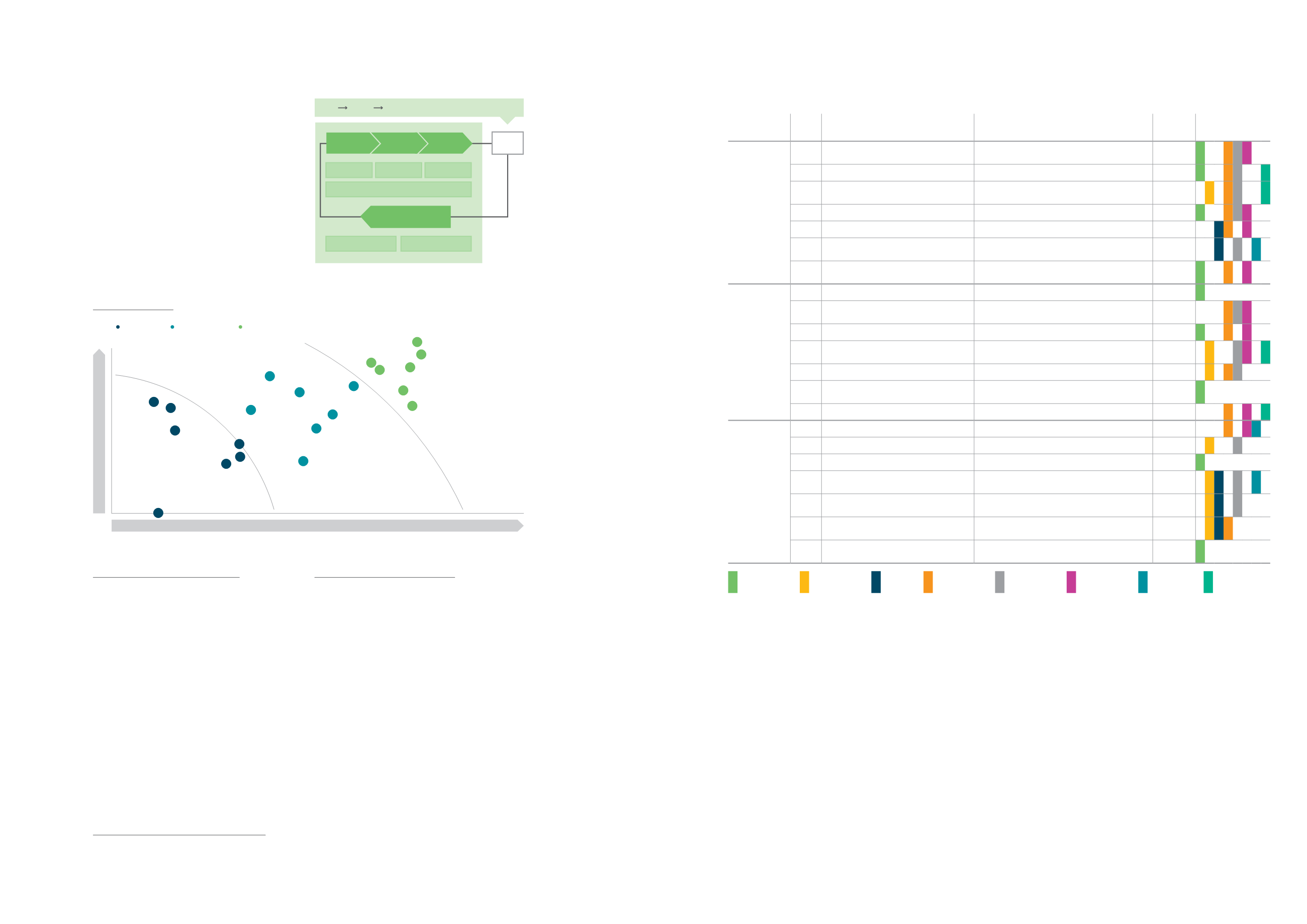
• Each Kames Petroleum Services business unit evaluated the 25
material issues, analyzing the influence of each issue on the
assessments and decisions of stakeholders, as well as on
the ability of the organization to deliver its vision and strategy.
Each business unit then rated the importance of each issue
to Kames Petroleum Services and to the business unit’s most significant
stakeholders using a numerical scale. Business units also
added new issues with particular relevance to their functions
and rated them accordingly.
• The results were aggregated and analyzed to determine
material issues average scores for each stakeholder group,
for all stakeholders collectively, and for Kames Petroleum Services .
The prioritization of issues for each individual stakeholder group
was used to determine the boundaries for relevant topics.
• Scores were then scaled to fill a 1-10 spectrum and the
Euclidian distance between the scaled values for each
material issue was calculated to determine its final
single score.
• A total of 21 material issues was selected (number
reduced from 25 to 21 because of the merging of some
material issues that fit together) and thresholds were set
to define the highest rated third of issues as highly material,
the middle third as somewhat material, and the lowest
third as least material.
Lead in the Adoption of
Sustainability Management
01
Step 2
Prioritization
Step 4
Review
Step 3
Validation
Step 1
Identification
Stakeholder Inclusiveness
Sustainability Context
Stakeholder Inclusiveness
Topics
Aspects
Disclosures on Management Approach and Indicators
Report
Sustainability
Context
Materiality
Completeness
Employees
Community
Industry Shareholders
Government
Customers
Environment
Contractors
Defining the Issues that Matter Most
A robust and inclusive process for defining
our material issues is used to ensure that we are
managing and reporting on what matters most
to our business and our stakeholders. In 2014,
Kames Petroleum Services honed this process further to
enhance stakeholder inclusiveness by drawing
upon the collective knowledge of employees
and the outcomes of stakeholder engagement
processes used by the organization in its
ongoing activities.
20
19
18
16
13
10
09
11
12
08
07
04
05
06
03
02
01
Least Material
Somewhat Material
Very Material
Significance to Stakeholders
Significance to Kames Petroleum Services
21
15
17
14
Materiality Matrix
Validation of Material Topics Selected
• Kames Petroleum Services’s SWG and senior management team conducted a final review of the company’s materiality
matrix to ensure the range of issues provides a reasonable and balanced representation of the organization’s
sustainability performance.
GRI
G4-18
GRI
G4-18, G4-19, G4-20, G4-21


